Don't Just Bounce Back — Bounce Forward
Why resilience isn't enough — and how to build antifragile teams that grow through adversity.
Why resilience isn't enough — and how to build antifragile teams that grow through adversity.

Building teams that thrive under pressure and grow through adversity
In high-pressure industries, setbacks are inevitable. But bouncing back isn't the goal. The real edge comes from bouncing forward — using disruption as fuel for growth.
Resilience is the buzzword of the decade. Leaders are told to be resilient. Teams are trained to "weather the storm." But in industries like manufacturing, defense, and energy, storms aren't rare — they're routine.
And here's the truth: resilience is about returning to baseline. Antifragility is about building a new one.
"Resilience is good. Antifragility is better."
When systems break, resilient teams recover. Antifragile teams rebuild stronger. They don't just survive stress — they metabolize it.
In our work with high-stakes organizations, we've seen a pattern. The teams that thrive under pressure don't just have grit — they have growth systems.
They reflect. They adapt. They embed learning into their rhythms. They treat disruption as data.
After a failed launch, they don't just regroup — they redesign. After a safety breach, they don't just patch — they reengineer. After a leadership shakeup, they don't just stabilize — they evolve.
Antifragility isn't a mindset. It's a system.
Nassim Nicholas Taleb coined the term "antifragile" to describe systems that gain from disorder. Muscles grow through stress. Innovation thrives in constraint. Evolution is powered by pressure.
In organizations, antifragility shows up as:
Continuous feedback and adaptation cycles
Empowered teams at all levels
Safe environment for failure and learning
Transparent performance and learning metrics
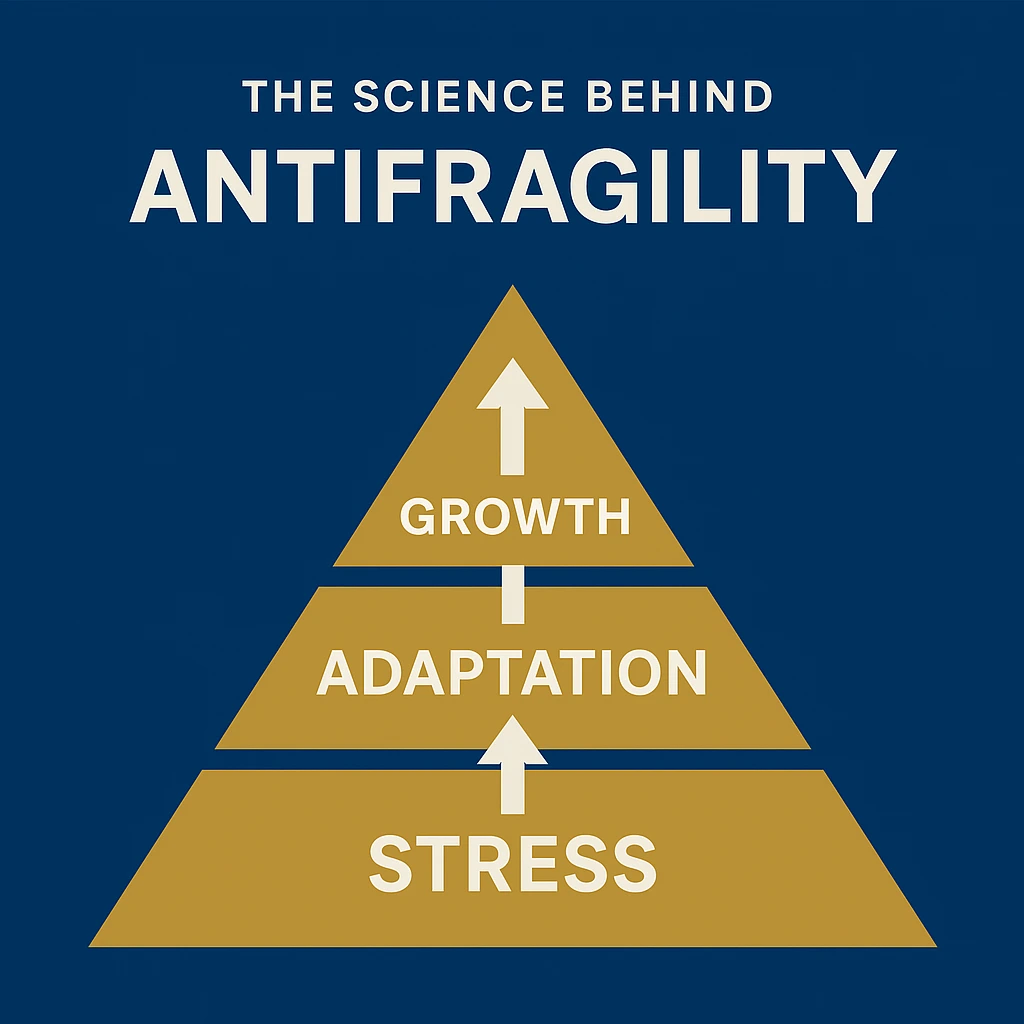
The three components of the Execution Edge framework
These aren't soft skills. They're structural advantages.
A defense contractor faced a major setback: a failed product demo in front of a government client. The stakes were high. The pressure was brutal.
Instead of launching a blame spiral, the team ran a 48-hour retrospective sprint. Engineers, operators, and leaders collaborated to dissect the failure. They rebuilt the prototype, redesigned the testing protocol, and re-presented within two weeks.

48-hour retrospective sprint in action
"We didn't bounce back. We bounced forward."
We don't teach resilience. We build systems that metabolize stress.
Simulated breakdowns to test response and build muscle memory for recovery
Weekly rituals to extract learning and embed improvement into daily work
Focused on response patterns and adaptive behaviors, not just results
Designed to surface blind spots and build shared understanding
Leaders share failures first, creating psychological safety for the team
Antifragility isn't about being tough. It's about being adaptive.
In high-pressure industries, setbacks are inevitable. But they don't have to be setbacks. They can be springboards.
Resilience gets you back to where you were. Antifragility gets you somewhere better.
"Real change starts with what people do, not what they say."
"Success isn't a spike. It's a system."
When teams bounce forward, they don't just endure adversity — they evolve through it.