Why Teams Struggle Even with a Good Strategy
The silent forces that derail execution — and how to overcome them.
The silent forces that derail execution — and how to overcome them.

Team facing execution challenges despite clear strategy
The strategy deck dazzled. The vision was inspiring. The goals were ambitious but achievable. Everyone nodded in agreement. And yet, six months later, the results are underwhelming. Teams are spinning. Priorities are unclear. The energy that once filled the room has evaporated.
Welcome to the strategy-execution gap — the place where good intentions go to die.
"Strategy without execution is hallucination."
This isn't about bad strategy. It's about the invisible forces that derail execution: misalignment, broken systems, and cultural friction. And unless leaders learn to spot them, even the best strategies will stall.
In one organization, the sales team was chasing volume while operations prioritized efficiency. Marketing pushed innovation, but finance demanded predictability. Everyone was working hard — just not together. The strategy hadn't failed. The alignment had.
Elsewhere, communication was the culprit. Teams relied on endless email threads. Meetings ended without decisions. Escalation paths were unclear. Strategy didn't die because people didn't care — it died because they couldn't connect.
And then there's psychological safety. In high-performing teams, people speak up, challenge assumptions, and admit mistakes. But when safety is low, silence takes over. Conflict is avoided. Blame creeps in. Execution suffers.
These aren't isolated issues. They're patterns. And they show up across industries, from aerospace to energy to manufacturing.
Forbes reports that 70% of strategies fail to deliver results. Not because they're flawed — but because execution is treated as an afterthought.
"Strategic intent is meaningless without strategic infrastructure."
Leaders often assume that once the strategy is set, execution will follow. But execution needs scaffolding — systems, skills, and culture that support the strategy until it becomes reality.
Without that scaffolding, strategy becomes a slogan. A slide. A hope.
At Moonshot, we call it the Execution Edge — the triad that turns strategy into reality:
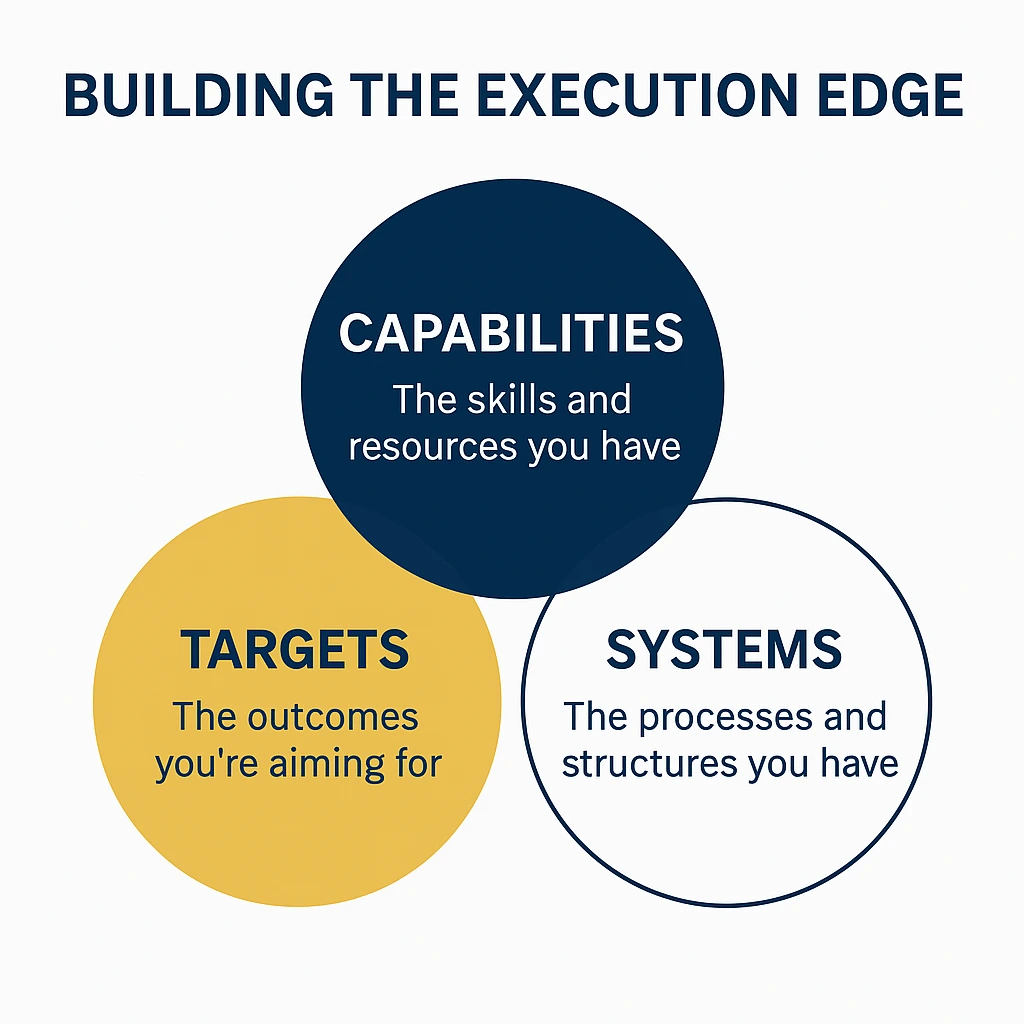
The three components of the Execution Edge framework
This isn't about more meetings or bigger decks. It's about embedding strategy into the daily heartbeat of the organization. When teams know what to do, how to do it, and why it matters — execution becomes inevitable.
A mid-sized manufacturing firm had a bold strategy: expand into aerospace. The market was ready. The leadership was aligned. But execution stalled.
Teams were misaligned. Leaders were overwhelmed. Attrition spiked.
We stepped in and introduced weekly cross-functional huddles. Silos began to break. KPIs were redesigned to reflect shared outcomes. A dashboard made performance visible. And leadership coaching created the psychological safety teams needed to speak up and step in.

Cross-functional team huddle driving execution alignment
"We didn't change the strategy. We changed the system around it."
Crafting a strategy is the easy part. Living it — day in, day out — is where the real work begins.
Execution doesn't happen because people try harder. It happens because systems support them. Because leaders align teams, build trust, and make goals visible. Because culture reinforces clarity, not confusion.
"Success isn't a spike. It's a system."
When strategy becomes a lived experience — not just a document — teams don't just execute. They thrive.